“Things Fall Apart, the Centre Cannot Hold:” The Silver Lining Between Decay and Resurgence as Seen in Miyazaki’s Spirited Away
by Mrittika Sengupta
by Mrittika Sengupta
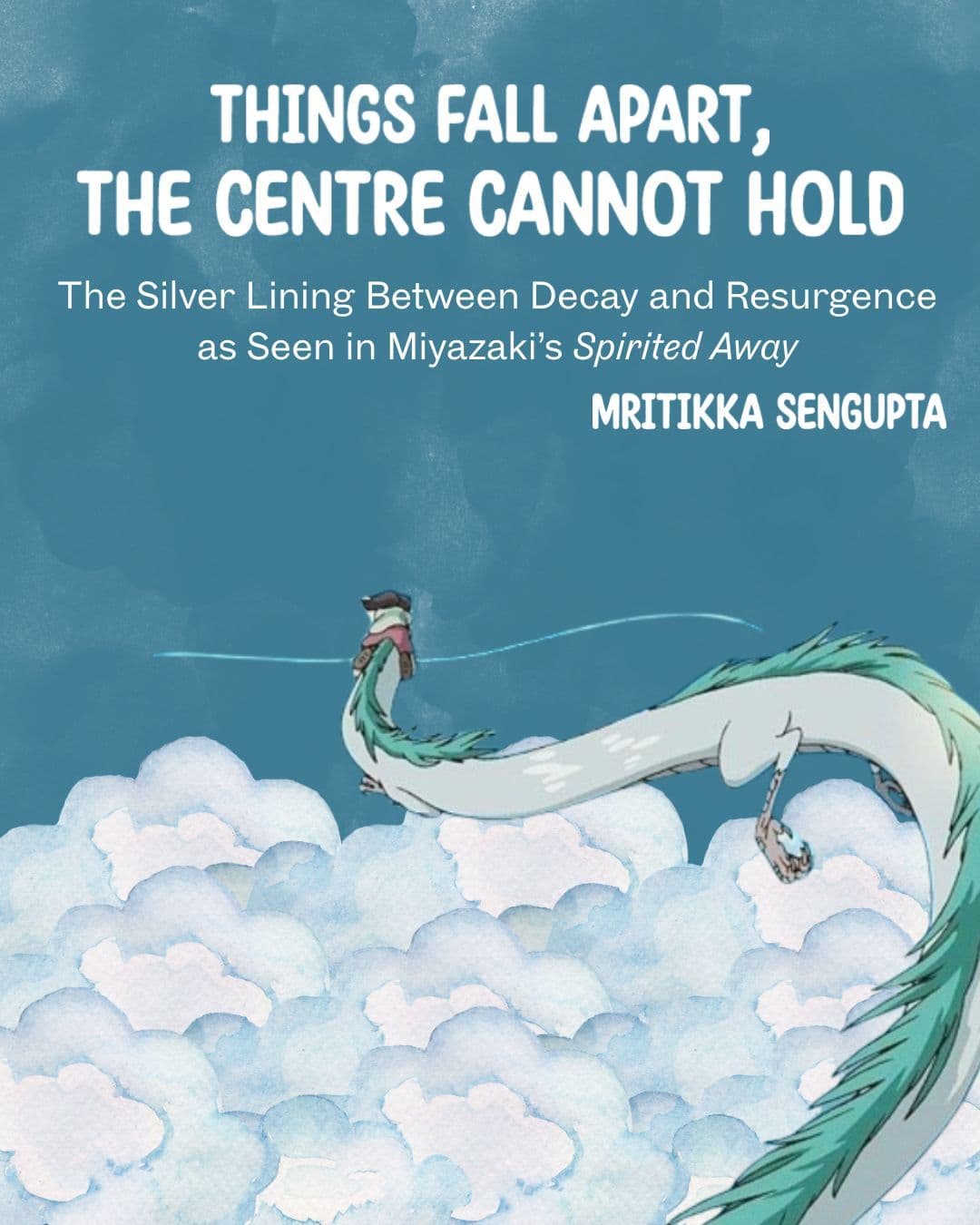
(Image 1 of 5)
Spirited Away (2001), a Japanese animated Studio Ghibli film written and directed by Hayao Miyazaki, is about the story of a young girl, Chihiro, who, along with her parents, discovers a secret world of spirits. The film narrates a story about the cyclical movement between erosion and regeneration through the portrayal of disruptive identity, language, and belonging of the protagonist, Chihiro, as she undergoes a series of varied experiences in the newly discovered spirit world. The attention towards minutely detailed characters, nuanced story telling, and brilliant visuals is what captivates the audience, but beneath its glory the film acts as an aesthetic and deeply philosophical inquiry about how new forms emerge from the remnants of what once was, thus deeply resonating with the complexities of human experiences.
The spirit world is full of kami, spirits from Japanese folklore, which Chihiro inadvertently discovered are marked by stratified decay and ruin. The bathhouse, although placed among the spirits, is one of the most human spaces in the movie where the sharp contrast between the bathhouse’s splendour surface and its underlying fatigue captures the living conditions of humans living under an exploitative capitalistic structure that drains us.The place exists as the form of a hybridised version of an institution where old traditions have decayed in nature and have turned automated, commodified. The gods who inhabit the bathhouse similarly embody this dissolution: the polluted river spirits, forgotten deities, and figures whose identities have eroded under the pressures of modern neglect. In this sense, the film visualises deterioration as an ongoing process rather than a discrete historical rupture.
From a postcolonial point of view, Noriko T. Reider’s article argues how the colonised individuals fight against distorted identities, sense of belonging, and language. Through the film’s narrative, the article analyses the allegory of colonialism where the identities are constantly constructed and contested. Upon eating the food for the supernatural creatures, Chihiro’s parents turn into pigs leaving Chihiro as a human body. While she explores to get help, she meets Haku who offers her help and introduces her to the bathhouse, a place for the supernatural, which is the only place where finding a job would break the spell and help re-enter the “humanworld” (Reider 5). The transformation of Chihiro’s parents into pigs is parallel to the dehumanization of the oppressed by the oppressors. Chihiro’s journey toward self-discovery, and the reclamation of her identity serves as a metaphor for the difficulties faced by the colonised people during the assertion of autonomy amidst colonial domination.
As well, the movie reflects a broader thematic emphasis on remnants and afterlives through portrayals of identities persisting in fragments like Haku's forgotten name, No-Face's shifting persona, the bathhouse's faded splendour. These residues complicate the linear narrative of decline by insisting on continuity as they function as material and symbolic substrates from which new articulations of self and community may arise. Miyazaki therefore positions decay not as an endpoint, but as a liminal zone where past structures continue to inform emergent ones.
Chihiro’s journey in the film also epitomises an individual’s journey towards reclamation of identity and self-discovery, underlying the existing complexities in the colonizer-colonised relationship. Her relationships produce openings through which regeneration becomes possible. No-Face, for instance, transforms not through punishment, but through the recalibration of social context: once removed from an environment that amplifies his desire and displacement, he stabilises into a gentler form. Renewal here is contingent upon shifts in relational structures rather than intrinsic moral binaries.
The spirit world, with its rigid hierarchies, dehumanising transformations, and renaming power exemplifies an exploitative structure. Chihiro’s ability to resist complete domination, remember her identity, and bring her parents back to human form demonstrates her power of self-knowledge as a tool of resistance, and decay as a condition that makes renewal legible by exposing what can be reworked, reclaimed, and reimagined.
References
[1] Banerjee, P., & Sahi, N. (2024). Echoes of colonialism and identity crisis: A postcolonial analysis of Hayao Miyazaki’s Spirited Away. International Journal of English Literature and Social Sciences, 9(6), 75–78. https://doi.org/10.22161/ijels.96.13 (ijels.com)
[2] Reider, N. T. (2005). “Spirited Away”: Film of the Fantastic and Evolving Japanese Folk Symbols. Film Criticism, 29(3), 4–27
ABOUT THE AUTHOR
As an undergraduate English student, whether it’s fiction, film, or pop culture, I enjoy digging into the stories that shape us. I enjoy exploring the intersections of visual media and literature correlating it with socio-political and often philosophical inquiries. I’m especially drawn to content writing that blends insight with accessibility, and I’m steadily finding my own voice as a researcher, and writer.
Instagram: c0rpseofmri
COMMENTS
No comments yet. How about you be a Star to Comment?