The Digital Panopticon
by Bella
by Bella
(Image 1 of 1)
Imagine a prison where everyone is being watched by only one guard, while simultaneously not being watched at all.
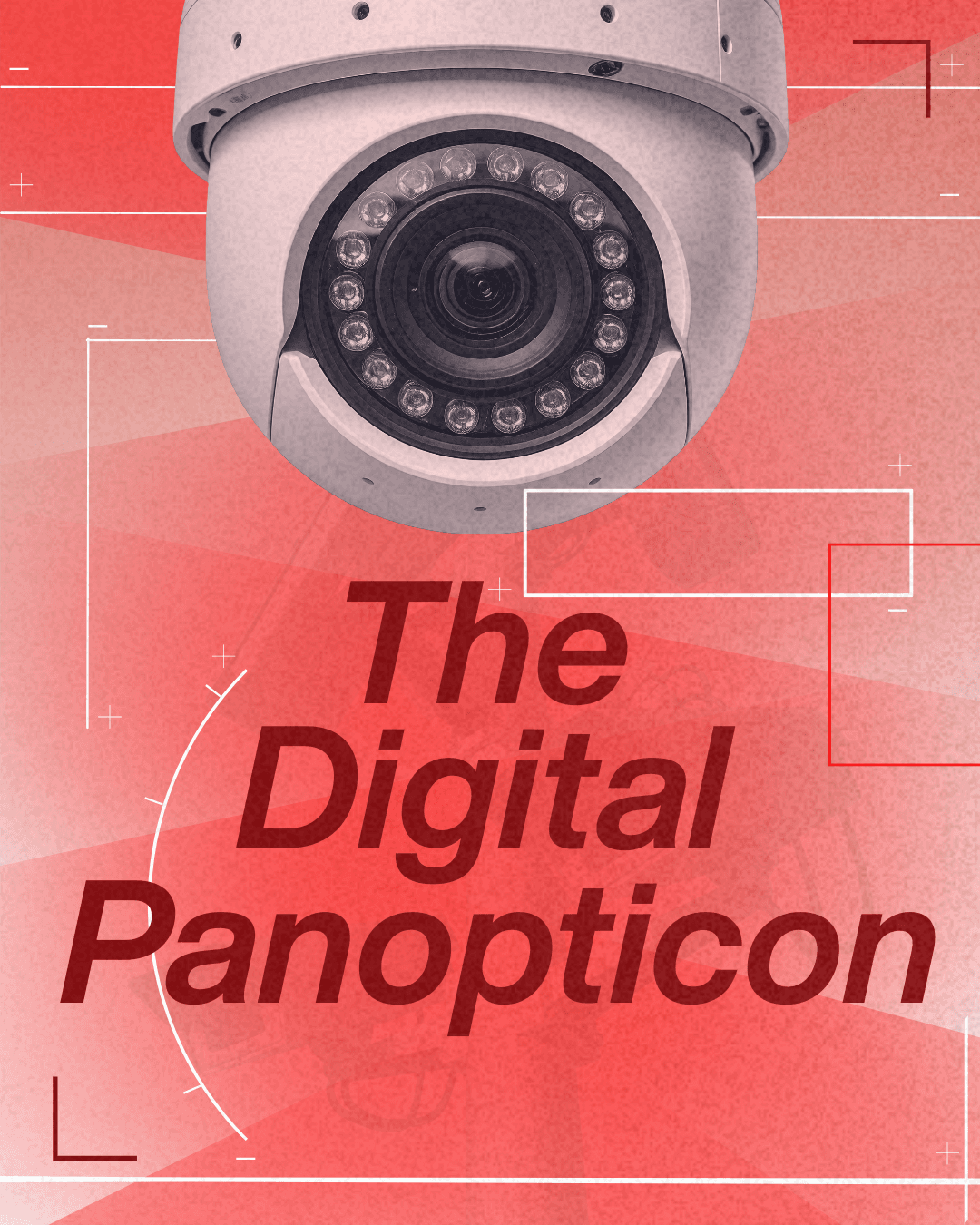
This concept was coined the "panopticon" by English philosopher Jeremy Bentham. It's a theoretical semicircle of cells where a singular guard could be watching any inmate at any time; there would be no way to know who's being watched, so inmates would all act as if they were being surveilled.
Like many old concepts, we have the technology to make it a reality. Since everyone has access to cameras—in their phones, doorbells, even glasses—it's hard to spend a day without being recorded.
Of course, security cameras are meant to prevent crime and deter burglars, but isn't it creepy that it's normalized to record people in public? You could be on the beach, at the boardwalk, eating curly fries when someone comes up to you, inquiring "Gay son or thot daughter?"; peeping toms can now record everything they see with their glasses; and there are countless other scenarios that make the sky seem like a big blue eye.
What makes something like a mall or even a school potentially worse that a panopticon is that fact that a guard can watch everything—if they have a camera system. Every aisle, hall, face, body—all being seen, judged. Even walking down the street makes you available to doorbells with black, hidden eyes. Although these measures can protect us from unsafe situations, should we be allowed to record people walking past our houses? Is that "security?"
People don't feel safe inside either. If you have a piece of tape over your webcam, or that thing that slides over your computer's camera lens, then you know what I mean.
It's also hard not to be posted to internet. People don't have much choice if they're in the background of an influencer's post at the gym, or if a friend shares a personal selfie. Some people even have parents that will post them to their public profile, leaving no choice to the child.
I think everyone knows the spiel about internet safety and privacy—although plenty ignore it by showing their faces and full government names online, alongside which school they go to, etc. These are all things that we should censor, but I think we've gone the wrong way with censorship.
If there is a situation where someone has died, we shroud it in euphemism—passed away, no longer with us, sleeping with the fishes. Unfortunately, social media doesn't allow this type of discussion, or that's what we think. This causes us to use algospeak: euphemism developed online to avoid being shunned by the algorithm. We don't allow ourselves to talk about guns, only pew pews, and benign words like "grape" and "PDF file" replace serious words.
This leaks into texts and platforms where you won't be banned for saying these words. We should be allowed to discuss serious topics without feeling the need to censor them. Of course, we shouldn't ignore the fact that these can be triggering—but that's why we have content warnings. Furthermore, we already have nicer words to exchange for triggering ones.
Back to the topic of surveillance: in many schools, there are programs that keep track of students' routines, performance, etc. Websites like SmartPass allow teachers to view a student's hall pass usage, but other people have access to it too. There are databases with how long children are going to the bathroom, the nurse, etc. while neither the students nor the parents consent to this data collecting.
It's also way too easy to find someone online. Even if your information isn't sold on a databroker website, you've more than likely given enough information for someone to create a detailed profile on you. All that being said, if you take away one thing from this, it's that you should be safer online (everyone collectively rolls their eyes). People are way too comfortable oversharing things with their full chest, and trust me, I know this from experience.
I want you to remember that no matter what, in the center of the panopticon, the guard is also being watched. Even if they can't be seen, they will have the same feeling as the prisoners, being trapped with eyes on them at all times.
ABOUT THE AUTHOR
No bio provided.
COMMENTS
No comments yet. How about you be a Star to Comment?